
Most plywood mills buy one sander and expect it to do two jobs. Calibration sanding sets the panel thickness and removes high spots; polishing sanding refines the surface for painting, laminating or film facing. Trying to do both with one head configuration usually means either the thickness is not accurate enough or the surface is not fine enough. This guide explains where the two jobs divide, compares the models we build for each, and shows how to choose a plywood sanding machine that matches your press output and surface standard.
The distinction matters most in export-oriented mills, where a panel that is 0.3 mm out of tolerance or carries visible sanding marks is not a cosmetic issue — it is a rejected shipment.
Two Jobs, Two Machines
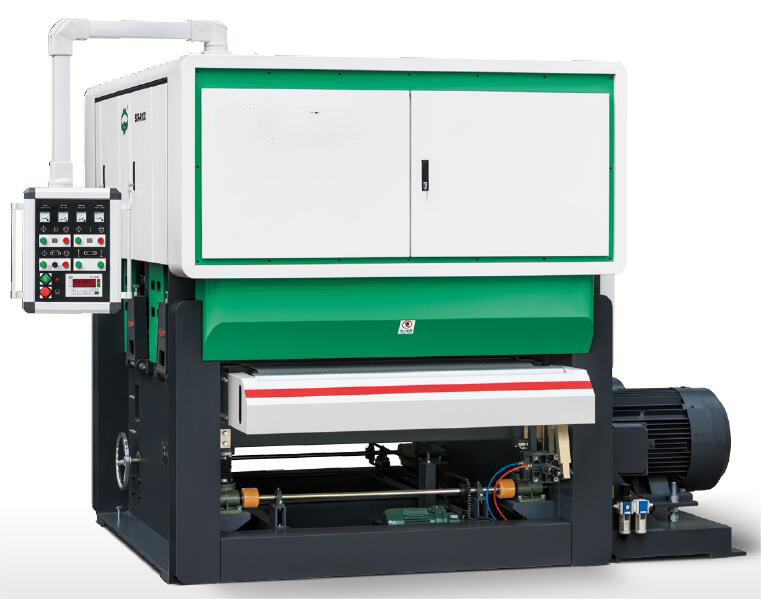
Sanding in a plywood line serves two different purposes, and the machine parameters follow from that difference.
| Sanding Type | Calibration sanding | Polishing sanding |
|---|---|---|
| Primary job | Set thickness and remove high spots | Refine surface smoothness |
| Typical removal depth | 0.3–1 mm | 0.05–0.2 mm |
| Contact roller | Steel roller | Rubber roller or polishing pad |
| Typical belt grit | 40#–80# | 180#–320# |
| Measured result | Tolerância de espessura | Surface quality |
Calibration sanding is a dimensional operation. It removes enough material to bring the panel to nominal thickness and to level the surface after pressing. Polishing sanding is a surface operation. It removes a very small amount of material and leaves a finish that accepts glue, paint, melamine film or veneer overlay.
A three-head machine can combine these functions — a steel contact head, a rubber contact head and a polishing head — which is exactly how our standard and heavy-duty sanders are configured. But if your product mix requires tight thickness control and a fine finish at high volume, a dedicated calibration sander followed by a polishing sander is usually the more predictable arrangement.
Calibration Sanding: Where Thickness Is Decided
Calibration sanding uses steel contact rollers with coarse belts. The steel roller is rigid, so it removes material aggressively and follows the panel’s high points rather than conforming to them.
Key parameters from our calibration sander:
- Working width 40–1300 mm, thickness 3–80 mm, panel length from 750 mm
- Contact roller 400 mm, steel or rubber depending on the head
- Belt size 1340 × 2800 mm at 24 m/s
- Feed speed 5–40 m/min
- Total power 142.5 kW, with 75 kW and 55 kW main motors
- Dust extraction 23,000 m³/h
- Working example: 18.0 mm ±0.2 mm
The 18.0 mm ±0.2 mm example is the number to keep in mind. Calibration sanding is not a finishing pass; it is the operation that determines whether the panel meets its declared thickness. If the incoming panel varies by more than the sander can remove, the machine cannot fix it — it can only remove material until the high spots are gone.
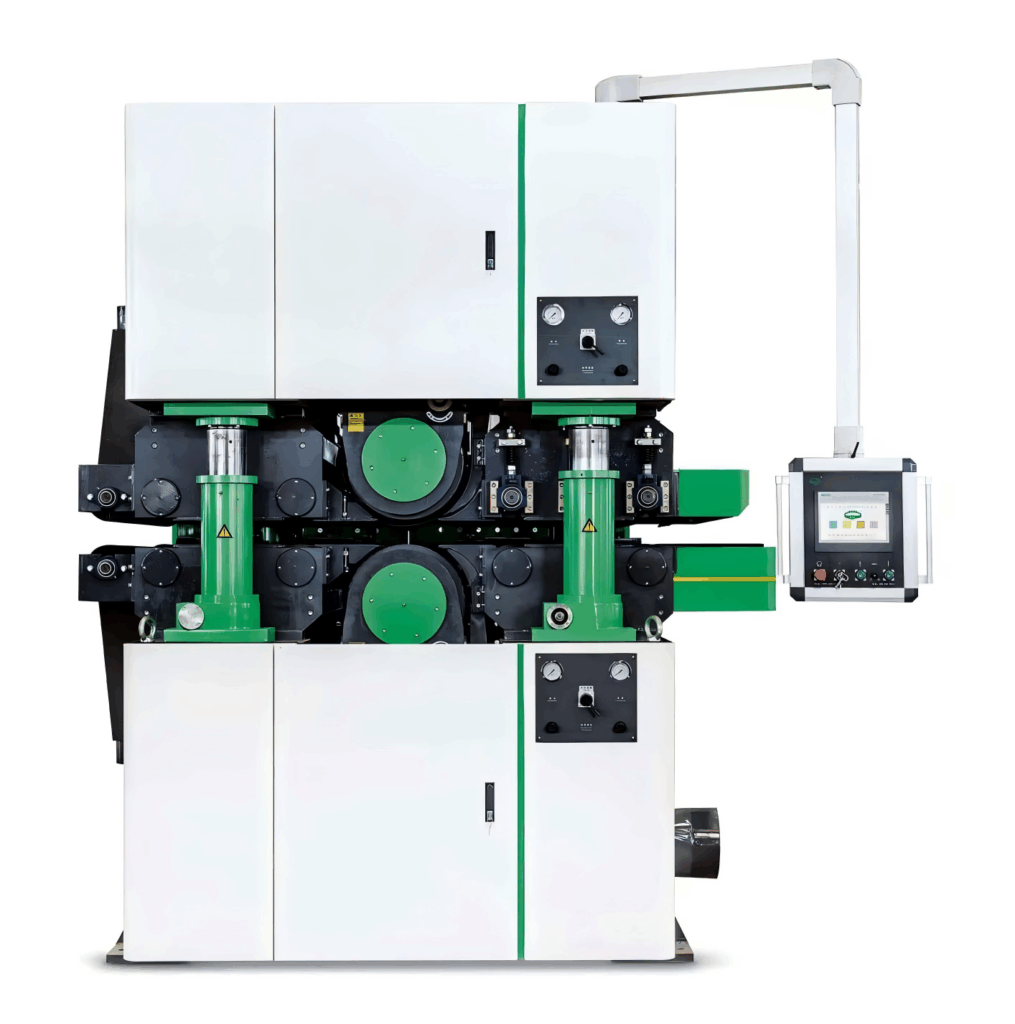
For high-volume core production, our double-side core calibration sander runs two 400 mm steel rollers with 75 kW motors on each side, covers 3–120 mm thickness (commonly 12–30 mm), and extracts 25,000 m³/h of dust. That configuration exists because core panels often need both faces calibrated before the face veneer is applied.
Polishing Sanding: Where Surface Quality Is Decided
Polishing sanding uses a rubber contact roller or a polishing pad with fine belts. Rubber conforms to the panel surface, so it removes less material and leaves fewer pressure marks.
Key parameters from our polishing sander:
- Working width 40–1300 mm, thickness 3–80 mm
- Contact roller Ø320 mm rubber, plus polishing pad
- Belt size 1340 × 2800 mm at 20/14 m/s
- Feed speed 3–80 m/min
- Total power 59 kW, with 30 kW and 22 kW main motors
- Dust extraction 10,000 m³/h
The lower belt speed and finer grit are deliberate. Running a coarse belt at high speed on a thin face veneer will cut through the surface before it polishes it. This is also why polishing machines are specified with lower power: the job is refinement, not material removal.
Belt selection is a sequence, not a single choice
In practice, grit selection follows a progression: coarse belts remove material and defects, medium belts level the surface, and fine belts produce the final finish. Skipping a step forces the next belt to do work it was not designed for, which shortens belt life and increases the risk of sanding marks.
Model Comparison
| Modelo | Best for | Thickness range | Belt size | Potência total | Dust extraction |
|---|---|---|---|---|---|
| Standard Three-Head Sander | General three-head sanding for standard panels | 3–80 mm | 1340 × 2800 mm | 75/55/45 kW main motors | To be confirmed by configuration |
| Plywood Calibration Sanding Machine | Thickness calibration and leveling | 3–80 mm | 1340 × 2800 mm | 142.5 kW | 23,000 m³/h |
| Double-Side Core Calibration Sander | Calibrating both faces of core panels | 3–120 mm (common 12–30 mm) | 1350 × 2850 mm | 160.5 kW | 25,000 m³/h |
| Plywood Sanding Polishing Machine | Surface refinement before coating or lamination | 3–80 mm | 1340 × 2800 mm | 59 kW | 10,000 m³/h |
| Heavy-Duty Hardwood Sander | Hardwood plywood, three-stage sanding | 2.5–80 mm | 1330 × 2620 mm | 83.25 kW | 15,000 m³/h |
| Light Model Plywood Sander | Small mills, MDF, blockboard and thin panels | 2.5–80 mm | 1330 × 2200 mm | 41.37 kW | 25–30 m/s duct velocity |
The heavy-duty hardwood model is worth a closer look because it shows how the three stages combine in one frame: a 37 kW steel roller head (Ø240 mm) for calibration, a 22 kW rubber roller head for leveling, and an 18.5 kW polishing pad head for finish. Feed speed runs 20–40 m/min, and the machine is available at 380 V or 415 V.
Reading the Specification: Five Numbers That Matter
When you compare a plywood sanding machine, five values decide whether it fits your line.
- Working width. Our models cover 40–1300 mm, which handles standard 1220 mm panels with margin. Confirm the actual panel width including trim allowance.
- Thickness range. 3–80 mm covers most plywood; the double-side core sander extends to 120 mm for special products. A machine rated to 80 mm cannot be pushed to 100 mm by adjusting pressure.
- Belt size. 1340 × 2800 mm, 1350 × 2850 mm, 1330 × 2620 mm and 1330 × 2200 mm are not interchangeable. Belt size drives running cost and local availability, so check what your region stocks before choosing a model.
- Power per head. Total power matters, but the distribution across heads matters more. A 75 kW calibration head behaves very differently from a 22 kW finishing head.
- Dust extraction volume. 10,000 m³/h on a polishing machine and 25,000 m³/h on a double-side calibration sander are not small differences. The ductwork and fan have to be sized for the machine you actually buy.
Dust Extraction Is Not Optional
Sanding generates fine dust continuously, and that dust does three kinds of damage: it scratches the panel surface if it is not removed, it builds up on belts and rollers, and it creates a fire and explosion risk in the ductwork.
Two arrangements are common:
- Single-machine system. A dedicated hood, duct and fan per sander. Simpler to install and easier to isolate.
- Centralized system. Several sanders share one duct network, fan and collector. More efficient at scale, but the duct design has to be balanced so one machine does not starve another.
Keep duct runs short and minimize bends. Every bend costs airflow, and a starved dust system shows up as surface scratches that look like sanding defects.
Why Sand-Through Is Usually an Upstream Problem
Sand-through — the condition where the sanding belt cuts through the face veneer — is often blamed on the sander. In most cases the cause is earlier in the line:
- Veneer thickness variation from the peeler, which leaves thin spots that cannot survive calibration
- Low-density zones caused by glue starvation or gaps in the core
- Over-calibration, where the operator removes more material than the panel can spare to reach a thickness target
- Mixed panel thickness entering the sander in the same batch
The practical check is to measure panel thickness before sanding and compare it with the target. If the incoming spread is wider than the allowable removal, the problem is upstream.
Matching the Sander to Your Line
A sander is a throughput stage, and it has to clear what the press produces.
- Press output per shift sets the minimum feed speed and head count.
- Panel size sets the working width and belt length.
- Surface standard sets whether you need one combined machine or separate calibration and polishing units.
- Dust extraction capacity has to be planned with the sander, not added afterward.
On a line producing standard formwork or furniture substrate, a three-head sander often handles both calibration and finishing. On an export line making film-faced or laminated panels, a separate polishing pass gives more control over surface quality.
Perguntas frequentes
Do I need both a calibration sander and a polishing sander?
Not always. A three-head plywood sanding machine with a steel calibration head, a rubber leveling head and a polishing head covers most standard production. Separate machines make sense when thickness tolerance and surface finish both have to be held at a high standard, or when the volume is high enough that one combined machine becomes the bottleneck.
How much material should calibration sanding remove?
Our product comparison specifies 0.3–1 mm for calibration sanding and 0.05–0.2 mm for polishing. The exact amount depends on how much thickness variation the press produced; if the required removal exceeds the allowable range, correct the upstream process instead of increasing sanding depth.
What belt grit should I use?
Calibration typically runs 40#–80# and polishing runs 180#–320#. Treat grit as a sequence: coarse to remove material, medium to level, fine to finish. Skipping a step shortens belt life and increases the risk of sanding marks.
How much dust extraction does a sander need?
It depends on the model. Our calibration sander requires 23,000 m³/h, the double-side core calibration sander 25,000 m³/h, the heavy-duty hardwood sander 15,000 m³/h and the polishing sander 10,000 m³/h. Size the fan and ductwork for the specific machine rather than the line average.
Can one sander handle both core and face veneer panels?
It can handle panels of different constructions, but the head configuration and belt sequence still have to suit the surface you are finishing. For thin face veneer, use rubber contact and fine grit; for core calibration, use steel contact and coarse grit.
Next Step: Match the Sander to Your Panel and Finish
The right sander is defined by three inputs: the panel size and thickness range, the surface standard your market requires, and the output your press delivers per shift. Send us those details along with your target tolerance, and our engineers will recommend the head configuration, belt specification and dust extraction capacity, usually within 48 hours.
Review our full sanding machine range here: www.guoyumachine.com/products