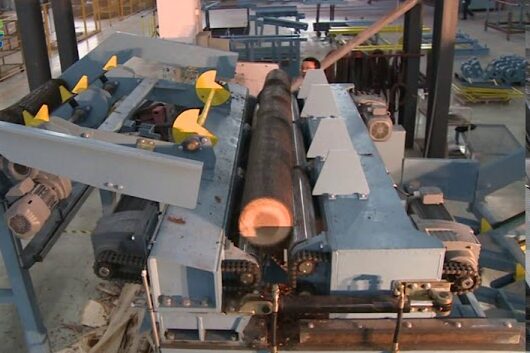

A plywood edge trimming machine is the last machine to touch the panel before it is stacked, packed or laminated. That position makes it disproportionately important: a press can produce a perfectly bonded panel, and a trim saw can still turn it into a reject with a crooked edge, a chipped corner or a diagonal error outside the customer’s tolerance. The right machine depends on four inputs — panel size range, required accuracy, output per shift and how much automation you can support.
This guide compares the DD saw, the roller-type trimming saw, the roller table edge saw and the double sizer, and shows how each one fits a different production profile.

What a Plywood Edge Trimming Machine Actually Decides
Trimming is often treated as a secondary operation. In practice it decides three things that customers inspect immediately.
Final dimensions. The panel leaves the line at its declared width and length, or it does not. The DD saw family and the double sizer both cut to fixed or adjustable dimensions, but they do it with different setup flexibility.
Squareness. Diagonal error is the number that separates a standard saw from a precision one. Our DD saws are specified within 0–0.5 mm, while the roller-type trimming saw is specified below 0.05 mm. For panels that will be laminated, edge-banded or assembled into formwork systems, that difference is visible downstream.
Edge quality. A scoring saw and a stable saw head reduce chipping. Both matter more as panel thickness and density increase.
DD Saw: Semi-Automatic vs Fully Automatic
The DD saw cuts both the long edge and the short edge of the panel. It is the most common trimming solution for standard 4 × 8 ft production because it is compact, proven and relatively simple to operate.
Semi-automatic DD saw
| Parameter | Specification |
|---|---|
| Panel size | 1220–1240 mm wide, 2440–2460 mm long |
| Cutting thickness | 0–70 mm |
| Diagonal error | 0–0.5 mm |
| Saw blade | 305 × 25.4 mm, 120 teeth |
| Scoring blade | 180 × 25.4 mm, 36 teeth |
| Saw speed | 7000 rpm |
| Main motor | 10 kW |
| Gewicht | About 6 t |
| Footprint | Long saw 6.0 × 2.12 × 1.22 m; wide saw 3.64 × 3.36 × 1.22 m |
The semi-automatic version suits mills running a single standard panel size with operators available to handle loading, alignment and stacking.
Fully automatic DD saw
| Parameter | Specification |
|---|---|
| Cutting range | 650–1270 mm wide, 1500–2800 mm long |
| Cutting thickness | 0–70 mm |
| Diagonal error | 0–0.5 mm |
| Main motor | 11 kW Siemens Beide |
| Linear guide | 30 mm |
| Control | Inovance PLC, Mitsubishi VFD |
| Betrieb | One operator at the touchscreen |
| Gewicht | About 6 t |
The fully automatic model widens the size range and removes most manual handling. For a line running three shifts, the labor difference alone often justifies the step up.
Roller-Type Trimming Saw: When You Need 0.05 mm
The roller-type trimming saw is the precision option. Instead of a conventional carriage, it uses a cast saw head machined on a horizontal machining center, supported by NSK bearings and controlled by a Siemens PLC.
| Parameter | Specification |
|---|---|
| Panel size | 1220 × 2440 mm |
| Maximum thickness | 60 mm |
| Cutting speed | 0–30 m/min |
| Diagonal error | Below 0.05 mm |
| Straightness error | Below 0.05 mm |
| Gesamtleistung | 37.68 kW |
| Gewicht | About 6 t |
| Feeding | Suction feed with fence-type automatic stacking |
This machine is the right choice when the panel will be laminated, edge-banded or used in a system where squareness is a functional requirement rather than a cosmetic one. The trade-off is that it is configured around a fixed 1220 × 2440 mm format, so a mill producing multiple panel sizes needs a different solution.
High-Volume Option: Roller Table Edge Saw
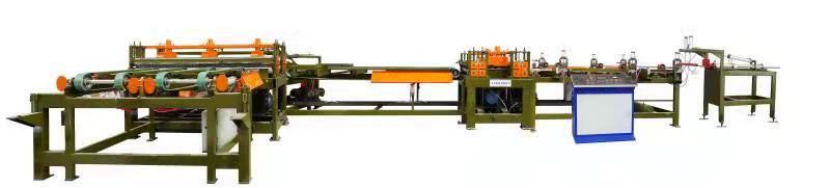
When output is the priority and 0.5 mm diagonal error is acceptable, the roller table edge saw is built for throughput.
| Parameter | Specification |
|---|---|
| Panel size | 4 × 8 ft |
| Output | About 400 sheets per hour, adjustable |
| Diagonal error | Below 0.5 mm |
| Gesamtleistung | 50 kW |
| Gewicht | About 6.5 t |
| Rahmen | 160 × 80 × 6 mm square tube |
| Main motor | 7,5 kW |
| Control | Delta PLC |
| Feeding | Suction feed with automatic stacking |
The 400-sheet-per-hour figure is a reference capacity, not a guarantee. Actual output depends on panel thickness, operator response, stacking cycle and how evenly the press feeds the saw.
Double Sizer: Adjustable Panel Sizes
The double sizer solves a different problem: producing more than one panel size without rebuilding the line around a fixed format.
| Parameter | Specification |
|---|---|
| Adjustable panel size | 670–1500 mm wide, 1200–2700 mm long |
| Cutting thickness | 0–70 mm |
| Diagonal accuracy | Within 0.5 mm |
| Main motors | 11 kW × 2 |
| Saw blades | 305 × 25.4 mm, 120 teeth; 180 × 25.4 mm, 36 teeth |
| Saw speed | 7000 rpm |
| Rahmen | 150 mm square steel tube |
| Linear bearings | Ø40 mm × 4, automatic lubrication |
| Control | Xinje PLC, 7-inch touchscreen |
The two saw stations — a longitudinal section of 8600 × 1200 mm and a cross section of 4600 × 3400 mm — mean the machine needs a larger floor area than a standard DD saw. That space requirement should be checked against the building layout before the order, not after delivery.
Model Comparison
| Modell | Best for | Panel range | Accuracy | Power | Automatisierung |
|---|---|---|---|---|---|
| Semi-automatic DD saw | Single standard size, lower capital | 1220–1240 × 2440–2460 mm | 0–0.5 mm diagonal | 10 kW main | Manual handling |
| Fully automatic DD saw | Standard sizes at higher volume | 650–1270 × 1500–2800 mm | 0–0.5 mm diagonal | 11 kW main | One operator, touchscreen |
| Roller-type trimming saw | Precision and clean edges | 1220 × 2440 mm | Below 0.05 mm | 37.68 kW total | Suction feed and automatic stacking |
| Roller table edge saw | High throughput | 4 × 8 ft | Below 0.5 mm diagonal | 50 kW total | Suction feed and automatic stacking |
| Double sizer | Multiple panel sizes | 670–1500 × 1200–2700 mm | Within 0.5 mm | 11 kW × 2 | Adjustable setup, PLC control |
Matching Trimming Throughput to Press Output
A trim saw that cannot clear the press becomes the bottleneck of the entire line. Three checks prevent that.
- Sheets per shift. Compare the saw’s reference capacity with the press output, allowing for thickness changes and stacking time.
- Automation level. Manual loading and stacking add seconds per sheet that compound across a shift. Suction feed and automatic stacking are not luxuries on a high-volume line.
- Size changeover. If you produce one standard size, a fixed-format machine is simpler. If you produce several, the double sizer’s adjustable setup avoids stopping the line for mechanical changes.
Two smaller details deserve a place on the checklist. First, confirm the saw blade specification — 305 × 25.4 mm with 120 teeth for the main cut and 180 × 25.4 mm with 36 teeth for scoring at 7000 rpm — and keep spare blades matched to it. Second, confirm the footprint and foundation requirements for the long and wide saw sections before installation.
Häufig gestellte Fragen
What is the difference between a DD saw and a roller-type trimming saw?
A DD saw cuts the long and short edges using a conventional saw carriage and is typically specified within 0–0.5 mm diagonal error. A roller-type trimming saw uses a cast saw head and roller feed, and is specified below 0.05 mm for both diagonal and straightness error. The DD saw is more flexible on size and capital cost; the roller-type machine is more precise.
What accuracy can I expect?
It depends on the model. Our DD saws are specified at 0–0.5 mm diagonal error, the roller table edge saw below 0.5 mm and the roller-type trimming saw below 0.05 mm. Confirm the tolerance your customer requires before choosing the machine.
How many operators does a fully automatic DD saw need?
One operator at the touchscreen. The machine handles the cutting sequence and the size settings, while the operator manages the line and quality checks.
Can one machine handle different panel sizes?
Yes — the double sizer adjusts from 670–1500 mm wide and 1200–2700 mm long, and the fully automatic DD saw covers 650–1270 mm wide and 1500–2800 mm long. Fixed-format machines are limited to their specified panel size.
What saw blades does the DD saw use?
A 305 × 25.4 mm main blade with 120 teeth and a 180 × 25.4 mm scoring blade with 36 teeth, running at 7000 rpm. Keep matched spare blades on site to avoid downtime when a blade is damaged.
Next Step: Match the Saw to Your Panel and Output
The right plywood edge trimming machine is the one that matches your panel size range, required squareness, output per shift and available floor space. Send us your panel dimensions, thickness range, target sheets per shift and quality standard, and our engineers will recommend the machine type, blade configuration and layout, usually within 48 hours.
Review our plywood trimming saw range here: www.guoyumachine.com/product-category/plywood-making-machine/plywood-dd-saw