
In Southeast Asia, logs reach the peeler at 50–60% moisture and the air around the drying line stays humid all year. Under those conditions, veneer moisture content is the single number that decides whether your plywood bonds or delaminates. Get it right and everything downstream — gluing, lay-up, pressing, sanding — becomes predictable. Get it wrong and no amount of glue or press pressure will save the board.
This guide covers the target values for different adhesives, the defects that wet or over-dried veneer causes, how to choose between roller, mesh-belt and combined dryers, and the practical settings that keep moisture stable in a tropical climate.
Why Moisture Control Is Harder in Southeast Asia
The problem is not the dryer. The problem is that moisture in this region moves in both directions.
Fresh logs arrive wetter. Our core veneer dryers are specified for an initial moisture content of 50–60%, and veneer peeled from freshly harvested plantation logs sits at the top of that range. In the rainy season, the number is both higher and less consistent.
Drying is only half the battle. Dried veneer left uncovered in humid air re-absorbs moisture before it reaches the glue spreader. A batch that leaves the dryer at 10% can be at 13% by the time it is laid up if storage and handling are not controlled.
Species behavior varies. Rubberwood, eucalyptus, acacia, Albasia (Sengon), Meranti and pine all release water at different rates, and mills that buy mixed log supply inherit all of that variation.
Volume hides the problem. On a 4-layer roller dryer running continuously, a small change in feed speed or chamber temperature affects a large amount of veneer before anyone notices. Moisture control has to be measured, not assumed.
The Target Numbers: From 50–60% to a Stable 10%
Before anything else, agree on the number your product requires. For most core veneer production in Southeast Asia, that number is a final moisture content of 10%, with a practical band of 8–12% and variation within a batch held to ±2%.
| Stage | Typical value | What causes variation |
|---|---|---|
| Veneer leaving the peeler | 50–60% initial moisture | Species, log storage, season, peeling thickness |
| Core veneer after roller drying | Target 10%; practical band 8–12%; within-batch variation within ±2% | Thickness, feed speed, chamber temperature, exhaust setting |
| Core and face veneer after combined drying | 12 ± 1% | Independent temperature zones for core and face sections |
| Before hot pressing | 5–12%, depending on the adhesive system | Adhesive type, glue spread, ambient humidity |
Two practical notes. First, these figures come from our equipment specifications — verify them against your own logs and your own meter before you lock in a production standard. Second, batch variation matters more than the average. A stack that averages 10% but ranges from 7% to 14% will produce more press rejects than a stack that sits consistently at 11%.
Moisture Content by Adhesive Type
The dryer does not set your final moisture target — your adhesive and your product standard do.
| Adhesive system | Recommended veneer moisture content |
|---|---|
| Urea-formaldehyde (UF) | 5–10% |
| Phenolic resin | 6–12% |
| Protein-based / soybean adhesive | 8–14% |
Beyond the adhesive, published bonding studies referenced in our technical notes point to a few practical rules:
- A moisture content between 5% and 15% supports good bonding strength, with 7–8% described as ideal.
- Keeping veneer in the 5–8% range minimizes deformation and surface cracking.
- Species with high resin content, such as pine, should be kept toward the lower end of the range to avoid bubbling during pressing.
- Species with good air and water permeability can tolerate slightly higher moisture without losing bond strength.
- If glue spread is reduced, a slightly higher moisture content can help maintain bonding strength.
In other words, “10%” is a production target for core veneer, not a universal law. A phenolic-bonded exterior panel and a UF-bonded interior panel do not want the same number.
What Goes Wrong When Moisture Is Off
Too wet
- Delamination, warping and surface cracks after pressing
- Steam pressure inside the panel during hot pressing, which causes blows and bubbles — most visible in resin-rich species
- Longer press cycles and higher energy consumption per cubic meter
- More glue needed to compensate for diluted adhesive on the veneer surface
Too dry
- Reduced bonding strength, because the adhesive cannot penetrate properly
- Brittle veneer that breaks during handling and lay-up
- Wasted energy and unnecessary over-drying, which is one of the quietest costs in a plywood mill
- Case-hardened surfaces that resist glue absorption
Uneven within the batch
This is the most expensive failure, because it is invisible until pressing. Mixed moisture across a stack means mixed glue absorption, mixed density and mixed press behavior. The result is sand-through, patchy bonding and reject rates that seem random but are not.
Choosing the Right Dryer
Dryer selection follows veneer thickness and the flatness your product needs — not the other way around.
| Dryer type | Best suited to | Veneer thickness | Key characteristics |
|---|---|---|---|
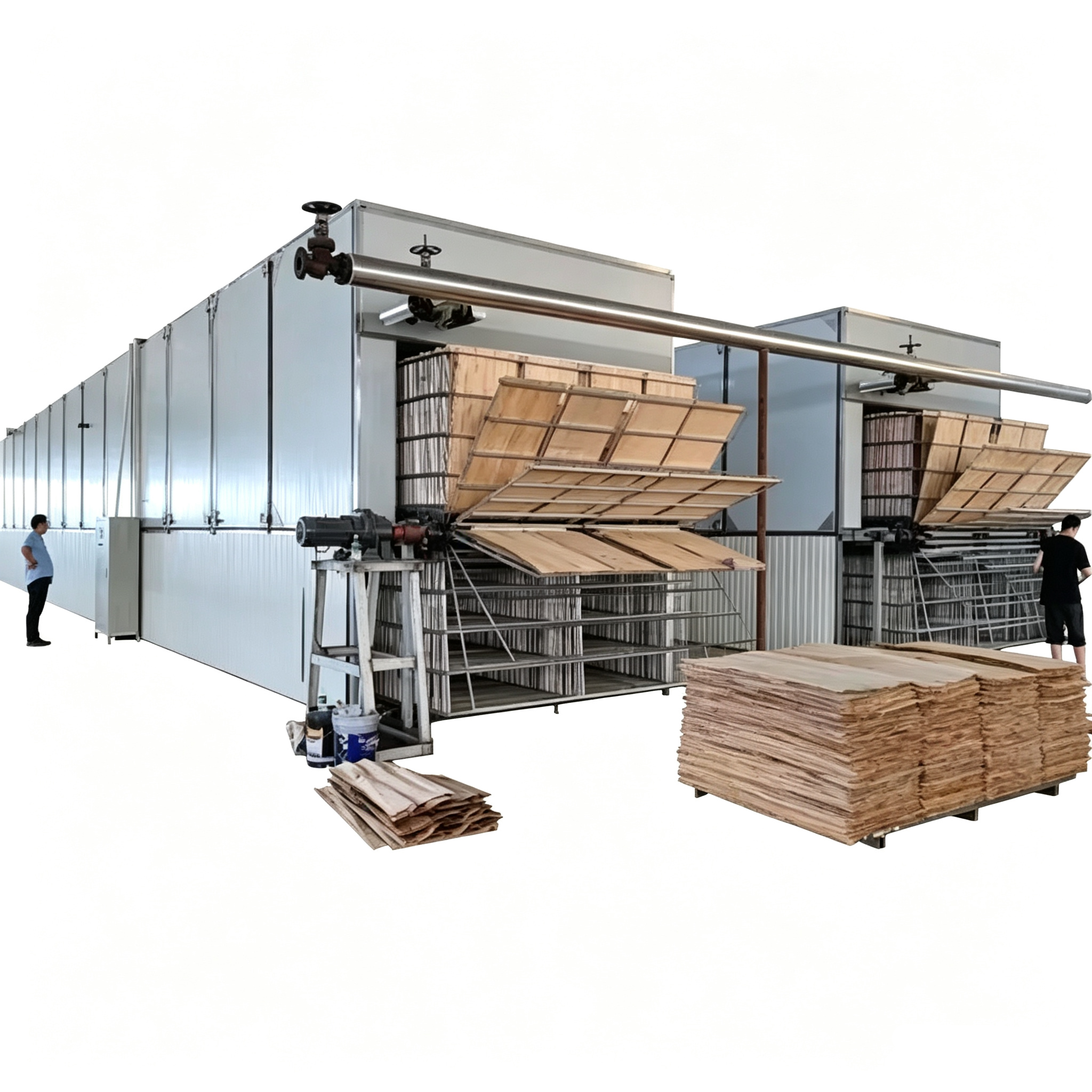
| Roller dryer | Core veneer, thick veneer, high output | 1.0–4.0 mm | Upper and lower rollers press the veneer flat while heating; multi-layer design for continuous volume |
| Mesh-belt dryer | Face and back veneer, thin and fragile sheets | 0.2–1.5 mm | Veneer lies flat on the belt without roller pressure, so thin sheets are not crushed or stretched |
| Roller + mesh 2-in-1 | Mills producing both core and face veneer | 0.2–6 mm | Independent temperature zones and variable-speed feeding for two products on one machine |
| Platen / hot-press dryer | Veneers with a high flatness requirement | Based on product | Dries while pressing; higher flatness, medium efficiency |
| Vertical / mesh-rack dryer | Lower capital cost, smaller footprint | Based on product | Lower investment than a roller line; confirm the achievable final moisture against your adhesive system |
What a core veneer roller dryer looks like in practice
For reference, our four-layer core veneer roller dryer is specified as follows:
- Initial moisture 50–60%, final moisture 10% (±2%)
- Drying temperature 150 °C, heated by thermal oil or steam
- Drying thickness 1.0–4.0 mm, capacity 6 m³/h
- Heating section 36 m (18 sections × 2 m), cooling section 4 m (2 sections × 2 m)
- 18 radiators, 6 moisture exhaust outlets of 300 mm diameter with frequency control
- Feed speed 1–30 m/min, total power 247.5 kW
Two settings that decide drying quality
Airflow direction. Longitudinal airflow loses speed along the length of the dryer and dries unevenly. Cross ventilation, where high-speed air is sprayed perpendicular to the veneer surface from both sides, breaks through the boundary layer and delivers more uniform drying. When you compare dryers, ask how the hot air meets the veneer.
The cooling section. Cooling is not dead time. It relieves internal stress so the veneer stays flat, and the temperature difference between the middle and the surface of the sheet drives out residual moisture. A dryer without an effective cooling section sends stressed, unevenly dried veneer to the glue spreader.
Fuel Choice: Where Southeast Asian Mills Save the Most
Drying is the largest energy consumer in most plywood lines, and fuel strategy often matters more than dryer brand.
Thermal oil or steam gives stable, controllable heat, but requires a boiler and purchased fuel.
Biomass wood-burning furnace burns what your own process throws away. If your line already runs a debarker with a crushing system and a waste conveyor, bark, chips and sawdust become free fuel instead of disposal cost. This is why the approach fits Southeast Asian mills particularly well.
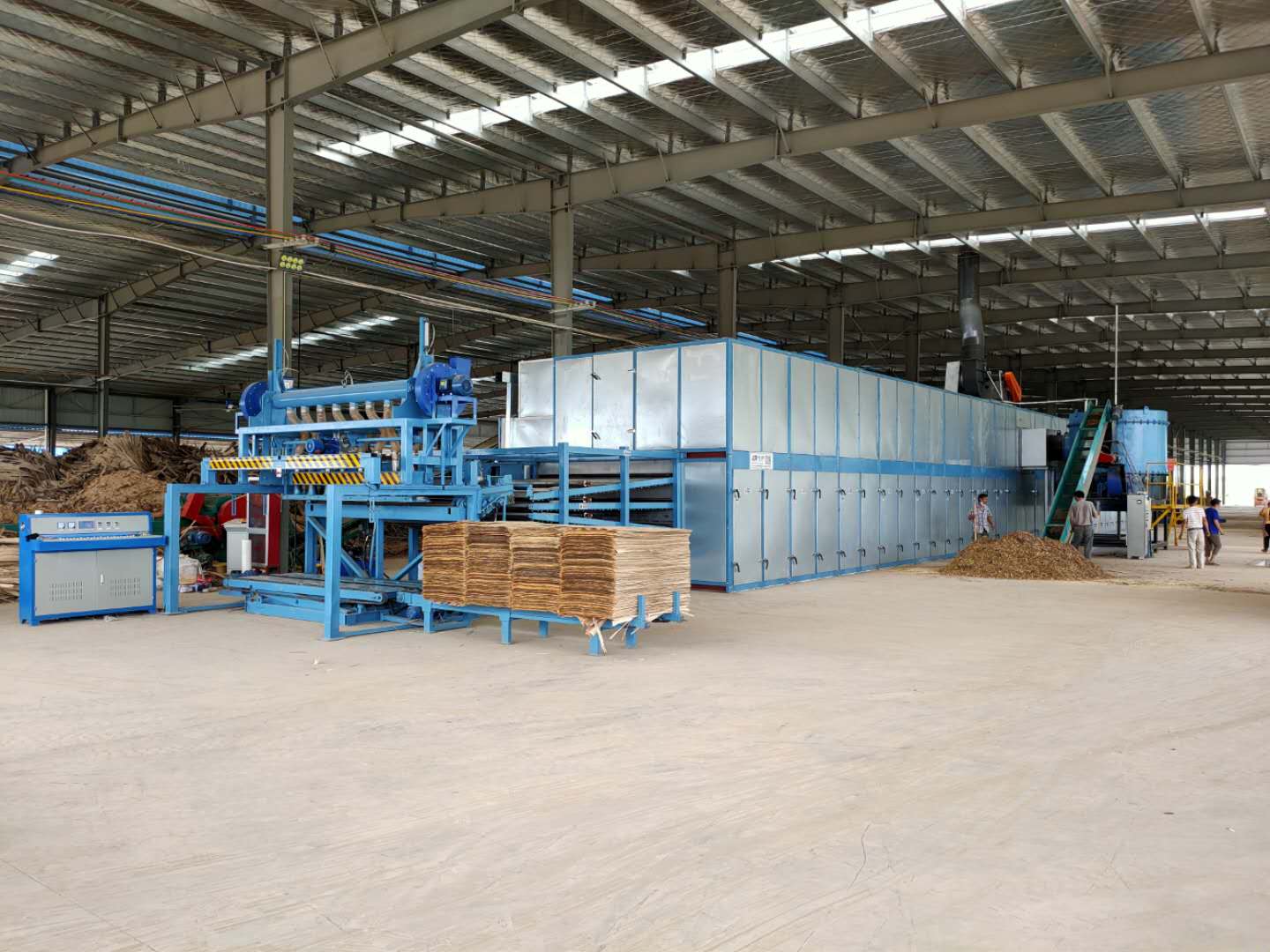
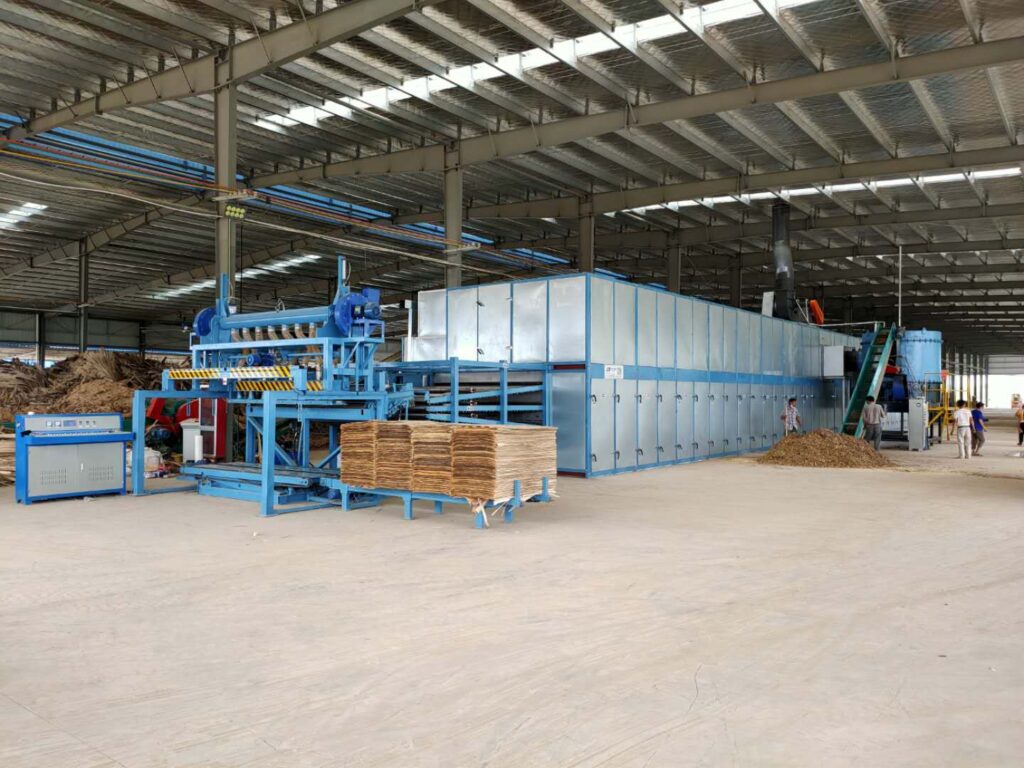
For reference, our 48 m double-deck veneer dryer with a wood-burning furnace is specified as follows:
- Suitable for eucalyptus veneer in 4×8 ft and 2×4 ft sizes, 1.6 mm thick
- Moisture reduced from approximately 50% down to 8–12%
- Capacity 2.5–3 m³/h
- Waste wood used as fuel, with the drying temperature adjustable between 140–180 °C
- Transport speed 5–22 m/min
- Total installed power 119.5 kW, with actual electricity consumption of approximately 80 kWh/h
- Listed thermal efficiency of 75–85%
- Burns crushed bark and other biomass, including wood chips, rice husks and biomass pellets
Fuel consumption per cubic meter of veneer depends on the moisture of the fuel and of the incoming veneer, so the fuel rate for your specific case is to be confirmed by our engineers.
Case Example: Rubberwood and Eucalyptus in Thailand
A Thai wood processing company peels and dries rubberwood and eucalyptus veneer. As output grew, its existing drying system could not hold moisture consistently, and energy costs were rising.
| Requirement | Solution |
|---|---|
| Initial moisture around 50%, target around 10% | 38 m double-deck roller veneer dryer |
| Use the factory’s own waste wood as fuel | 2 m wood-burning furnace replacing a conventional boiler |
| Continuous production with stable quality | Automatic temperature control and speed regulation |
The equipment was manufactured in two months and installed and commissioned in 30 days. In operation, moisture content held close to the 10% target with minimal variation between batches, and the common problems of jamming, over-drying, cracking and edge curling did not appear. The biomass furnace replaced diesel and coal-fired boiler fuel, cutting energy cost and recycling the plant’s own wood residue.
A Practical Drying Checklist for Southeast Asian Mills
- Measure veneer moisture content entering and leaving the dryer, in the middle of the stack rather than only at the edges.
- Set feed speed by thickness, not by target output. The same dryer covers 1–30 m/min, but thin veneer and thick veneer cannot run at the same setting.
- Keep the cooling section working. Flat, unstressed veneer starts here.
- Manage exhaust deliberately. Frequency-controlled exhaust outlets let you match moisture removal to the load instead of running full open.
- Cover dried veneer. In humid air, uncovered stacks climb back toward ambient moisture within hours.
- Verify with two methods. A calibrated handheld meter for daily checks; oven-dry testing as the reference standard.
- Log defects backward. If delamination or warping appears, check moisture before adjusting glue or press parameters.
- Match species to settings. Rubberwood, eucalyptus, Albasia and pine do not dry identically, and mixed log supply requires more frequent verification.
Часто задаваемые вопросы
What is the ideal moisture content for veneer before hot pressing?
It depends on your adhesive: 5–10% for urea-formaldehyde, 6–12% for phenolic resin and 8–14% for protein-based adhesives. For core veneer in general, 7–8% is described as ideal for bonding strength, and 5–8% minimizes deformation and surface cracking.
Can one machine dry both core veneer and face veneer?
Yes. A roller and mesh 2-in-1 dryer handles 0.2–6 mm veneer with independent temperature zones, producing around 12 ± 1% final moisture. It reduces investment and floor space for mills that sell both core and face veneer.
Why does veneer crack or warp inside the dryer?
Usually one of three reasons: drying too fast for the thickness, temperature too high for the species, or roller pressure that is excessive for thin sheets. Core veneer should follow its own thickness range and flatness requirement rather than a single “fast” setting.
Do I need a boiler to run a veneer dryer?
Only for thermal oil or steam heating. A biomass wood-burning furnace generates hot air directly and lets you burn your own bark, chips and sawdust, which removes the boiler and reduces purchased fuel.
How long does a drying line take to install?
On a recent project in Thailand, the dryer was manufactured in two months and installed and commissioned in 30 days. Schedule depends on dryer length, on-site civil work and the availability of your own installation crew.
Next Step: Match Your Drying Line to Your Species and Adhesive
Veneer moisture content is not a machine setting you copy from a catalogue — it is a production standard you define from your species, your adhesive and your target market. Send us your wood species, veneer thickness, target output and glue system, and our engineers will recommend a drying configuration with the matching temperature, layer count, heating length and fuel option, usually within 48 hours.
Review our veneer drying equipment here: